Calling-off lesson rule
H is for HawkThe Calling-off lesson rule is a practical principle of falconry: when a hawk does not answer a recall promptly, the falconer should end the session and try again later rather than continue calling and waiting. It makes the timing of the lesson part of the training itself. Mabel’s early flights show the rule working through brief, successful repetitions; T. H. White’s experience with Gos shows what can happen when a session continues without a clear, well-timed response. The contrast shifts attention from a supposedly difficult bird to the human choices that frame its learning.
Definition and purpose
A calling-off lesson teaches a hawk to fly immediately to an upraised glove in response to a whistle. The desired response is rapid: the bird should come straight away. If it does not, waiting for minutes while continuing to whistle and call offers no useful lesson, so the session should stop and be attempted again later. The rule is not simply a matter of ending an unsuccessful exercise. It protects the clarity of the association the training is meant to establish, rather than letting an extended interval blur the connection between the recall, the flight, and the reward.
The method is shown with Mabel using a creance attached to her jesses. The line allows the exercise to take place under control, while the glove and food provide the immediate destination and reward. The rule’s emphasis is on a clean response and a timely consequence, not on making a hawk comply through repeated calls or prolonged waiting. Its compactness is significant: a short lesson that ends when the response is absent can be more instructive than an apparently persistent session that has lost its purpose.
Mabel’s lesson in practice
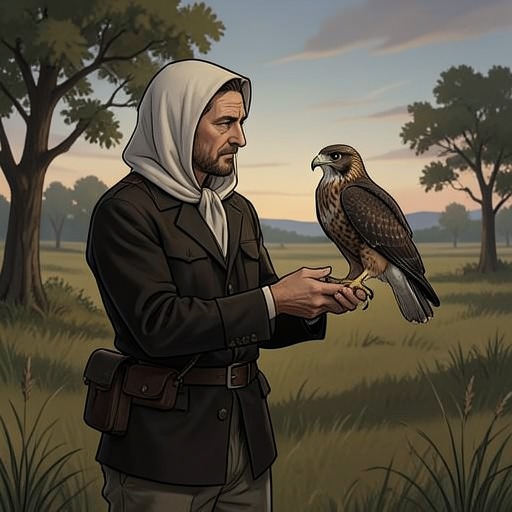
Mabel begins on the rail of a wooden veranda, facing the falconer in a low crouch. At six feet, she flies to the extended glove when called and eats a piece of chick. The exercise is repeated from farther away: at eight feet she makes the flight in three wingbeats and receives another reward. On the third turn, she launches before the falconer has fully turned away, and the glove is extended in time for her to land and eat. The sequence moves from a prompt response at close range to a still more immediate one, with distance increased gradually rather than by prolonging a failed attempt.
The falconer ends the work after this successful repetition, reconnects Mabel’s leash, and removes the creance. The decision to stop is part of the rule’s practical rhythm: the lesson has produced the response it was meant to teach, so there is no need to continue. Mabel has flown perfectly in the exercise, and the falconer’s pleasure continues afterward. Yet tears arrive later that evening, despite the happiness of the training; the account holds the successful lesson alongside the falconer’s continuing grief after her father’s death. The rule belongs to the concrete business of training, but its scene also shows how a successful, bounded task can briefly give shape to a difficult day without erasing what remains painful.
T. H. White and the cost of continuing
T. H. White’s first attempt to call Gos provides the principal contrast. The rule explains why that episode is painful to read: White does not know that a failed response should bring the lesson to an end. The falconer continues waiting and calling, and the timing of the reward is also poor, leaving the exercise without a clear lesson for Gos. Most strikingly, when Gos begins to approach, White runs away. The episode therefore exposes a gap between the action White intends—to call the hawk to him—and the effect of his own conduct, which interrupts the very response he has been seeking.
White returns to the exercise two days later. This time Gos is on the railings while White calls from forty yards away, offering butcher’s steak. He uses several different tones over ten minutes before Gos flies. The distance makes the approach a considerable success, but the arrival also brings White’s fear to the foreground. He struggles to remain in place, then retrieves Gos and tries again. On a further call, from fifty yards, he manages not to duck away. White’s account connects that effort to a longstanding fear of failing to be brave and to his mother’s appeal that he grow into a brave and honourable man. He celebrates the successful flight and his own endurance, but the episode also shows how a training session can become entangled with a human test of courage. The calling-off rule offers a different measure of success: not how long a falconer can persist, but whether the exercise remains clear and appropriately timed.
The falconer’s responsibility
The contrast between Mabel and Gos makes the rule a principle of human responsibility as well as a training instruction. Mabel’s exercise is divided into short attempts, with food following the desired response; White’s first effort with Gos becomes prolonged and confusing. The difference lies not in proof that one hawk is easy and another difficult, but in the organization of the encounter. A falconer’s timing, patience, and ability to end an unproductive session affect what the bird can learn. The rule accordingly resists treating a hawk’s failure to answer as a reason simply to intensify the same exercise.
This emphasis sits within the book’s wider challenge to inherited judgments about goshawks. Older falconry writing often described them as sulky, contrary, or difficult, while earlier accounts also presented them as shy and fearful birds that could respond to kind and considerate treatment. The Calling-off lesson rule does not itself settle the history of those descriptions, but it directs attention toward the falconer’s actions rather than making the hawk’s temperament the only explanation for a failed lesson. That perspective also matters in a tradition shaped by unequal access: flying falcons properly required expanses of open land associated with wealth and privilege, while goshawks could be flown in closer quarters. In Maine, the book describes a contrasting hunting culture in which land could be hunted over under common law. These contexts differ, but together they make visible that practical methods of falconry operate within social arrangements as well as individual encounters.
Scope and significance
The rule is deliberately modest. It does not promise that a hawk will always return, nor does it claim that every training difficulty can be solved by ending a session. Its stated instruction concerns a particular lesson: if the hawk does not come promptly, stop and try again later. Its importance comes from the distinction it draws between repetition that teaches and persistence that merely prolongs uncertainty. Mabel’s short flights give the principle a concrete form; Gos’s lessons show its stakes when the falconer’s fear and confused timing enter the exercise. Together, the episodes present calling off not as surrender, but as disciplined attention to what the encounter is actually teaching.